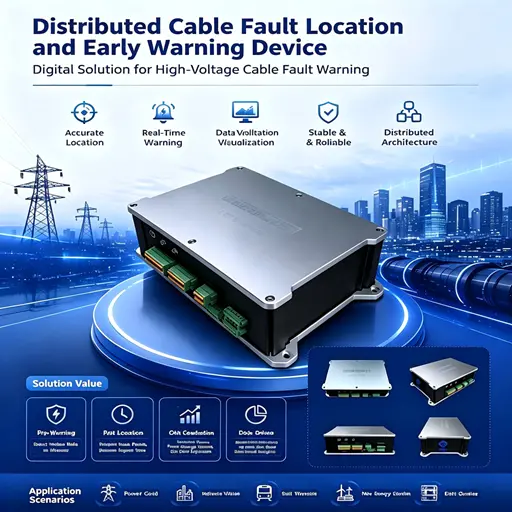
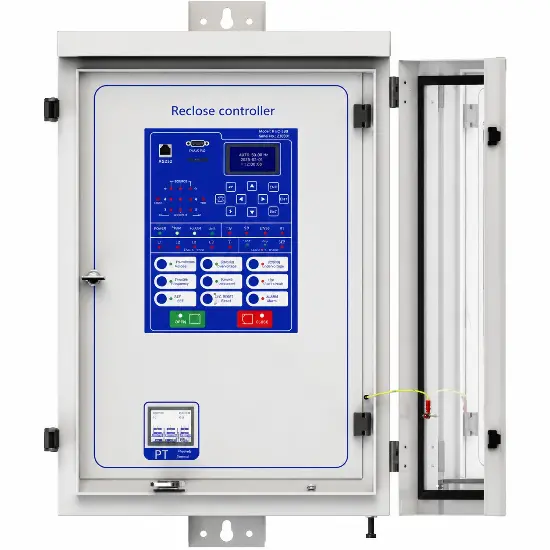
Centralized server intelligence remains essential for precise traveling wave fault location in modern distribution grids
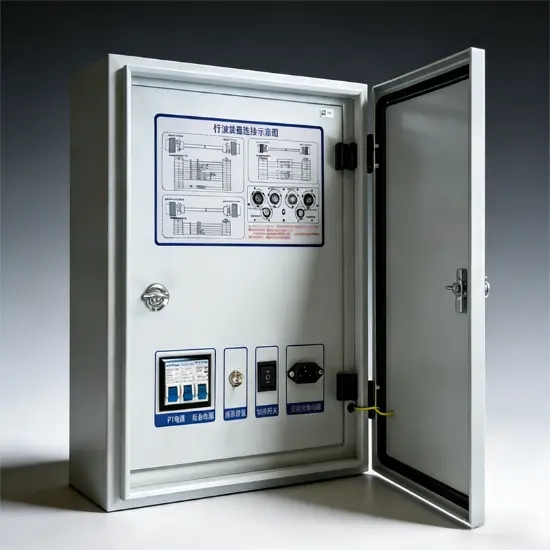
WENZHOU, China — October 20, 2025 — As edge computing continues to evolve, a debate has emerged within the power industry: can autonomous traveling wave terminals fully replace the master station in fault location? While the "intelligence at the edge" trend is undeniable, recent field deployments in Wenzhou’s smart grid pilot projects demonstrate that the master station server remains the indispensable "brain" required to navigate the labyrinthine complexities of modern distribution networks.
Navigating the labyrinth of heterogeneous networks
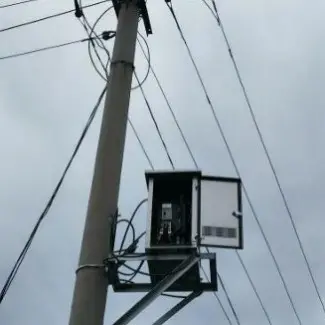
Distribution networks are inherently more complex than simple transmission lines. They feature wide geographic coverage, numerous branches, and a heterogeneous mix of overhead lines and buried cables. In such an environment, traveling wave signals undergo intricate refraction and reflection at every junction.
A standalone terminal only possesses a "tunnel vision" view of its localized measurement point. Without the macro-perspective of the master station, terminals often struggle to distinguish between initial fault waves and reflected interference. The master station aggregates data from across the entire network, utilizing global signal screening and redundancy elimination to ensure that "ghost waves" do not trigger false alarms.
Topology flux and the need for real-time SCADA integration
The distribution grid is a living entity. Dynamic operations—such as interconnection switching, load transfers, and routine maintenance—result in real-time shifts in network topology and parameters.
Standalone terminals are inherently blind to these system-wide changes. Relying solely on field devices would lead to positioning errors based on outdated network models. The main center-server bridges this gap by integrating with the SCADA system, allowing the fault location algorithm to dynamically adjust its calculation strategy based on the most current topological state. This synergy between "live" data and traveling wave analysis is the baseline for modern grid resilience.
High performance computing for heavy duty algorithms
Precision in traveling wave fault location requires computationally intensive math, including wavelet transforms, spectral analysis, and fine-grained wave-head identification. While hardware is improving, field terminals are still constrained by size, power consumption, and cost.
By offloading complex logical calculations to the master station, utilities can deploy cost-effective terminals for high-speed data acquisition while reserving the "heavy lifting" for high-performance servers. This centralized approach allows for the storage of vast historical datasets, which are critical for continuous algorithm optimization and long-term fault pattern analysis.
From data silos to closed loop management
Fault location does not exist in a vacuum. To be truly effective, it must be cross-verified with protection actions, fault recordings, and switch status changes.
The master station acts as the ultimate verification layer. It performs cross-system logic checks—for instance, confirming if the calculated fault point aligns with the specific protection zone that tripped. Once verified, the master station automatically dispatches the coordinates to the field maintenance teams. This seamless transition from "signal detection" to "on-site repair" creates a closed-loop business process that standalone terminals simply cannot facilitate.
In the pursuit of the "self-healing" grid, the master station is not a relic of the past; it is the critical orchestrator that transforms raw electrical ripples into actionable operational intelligence.